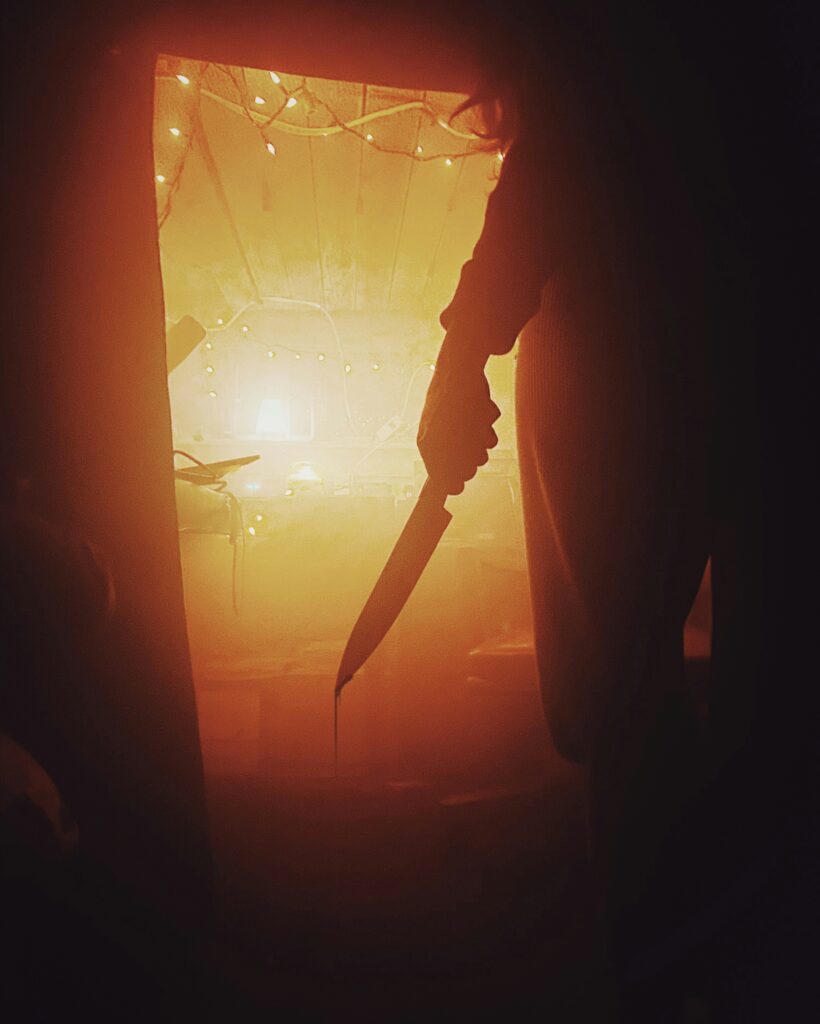
Should Christians watch horror movies?
Solomon Palmer, Staff Writer
Photo courtesy of Kyle Johnson on Unsplash
Horror movies have become a staple of October evenings, and entertainment as a whole. Ever since the genre’s explosion in the 80s, the horror film industry has only grown in popularity and special effects advancement. There are no signs of these flicks falling out of vogue in the foreseeable future, partly due to the continual shark-jumping and envelope-pushing.
The horror genre inherently leaves much room for the absurd and shocking, and as a result, has little guardrails concerning their production. The lack of neutrality demands the discernment of its individual viewers, but how does a Christian concern itself with horror movies according to a standard outside of themselves?
Kelechi Benet is an assistant professor of communications at North Greenville University, and has been teaching the elements of film to his students for almost six years. He ultimately seeks out realism in the movies he consumes, and this combined with his faith draws hard lines in the sand when it comes to horror movies.
“I’ve only watched one of what I would consider a horror movie in my life: ‘The Exorcist’ as a 15-year-old.” Benet reflects on his most recent horror watch. “I like realism in movies. But ‘The Exorcist’ went beyond realism, to the supernatural realm, and I found it deeply disturbing.”
Benet is of the film belief that art has a non-neutral effect on our spirits, and that the reality of the spirit realm is not something to be taken lightly.
Dallas Vandiver, associate vice president of student ministries, runs his media consumption by the Bible, rather than his internal inclinations.
“Philippians 4:8 tells us to think on what is just, pure and beautiful. 1 Corinthians 10:23 says that not everything that is legal is good for us.” Vandiver cites the Christian standard for our spiritual safekeeping.
However Vandiver also points out the concept of Christian freedom, which is the leeway for Christians to come to their personal conclusions when the Bible does not explicitly outlaw or encourage something. “The Bible does not explicitly forbid the consumption of violent or dark media; Philippians 4:8 tells us what to think about, not what type of entertainment to watch. This is something up to the believer for the most part to discern.” However, it is important to remember that what we consume will inform our thoughts.
Benet uses this personal discernment to draw the line at spiritually disturbing horror, and gratuitous media as a whole. “There is a difference between superpowers and the supernatural; the MCU is far from demonic. The supernatural, however, is a biblical reality. We see Jesus Himself deal with evil spirits, but not in an entertaining way.”
“Ultimately what gives art value is if it is truthful,” Amy Dunlap, associate dean of the school of arts, explained. “Even if that truth is not present in everyday life, horror movies can explore themes of fear and the unknown.”
Vandiver, however, does acknowledge the potential of horror media. “Disturbance can be an effective way to make your audience feel and walk away with something. ‘Frankenstein,’ for example, was a clear warning about human industrialization without forethought. It is possible to disturb your viewers without gratuitous shock value.”
So the consensus on horror consumption is to personally discern through a biblical lens. As Christians we are not called to hide from the world, or automatically rule out any media that is not overtly Christ-oriented. But what is the fate of directors’ souls? Are they sentenced to Hell purely for our superficial enjoyment?
“I believe there is no such thing as a Christian filmmaker. The identity of a Christian is a personal relationship between the individual and God.” Benet argues. He goes on to explain that a filmmaker can make a movie specifically for the Christian audience, but that the two labels are far more than mutually exclusive.
“I would go a step further and say that there is no such thing as a Christian movie,” Dunlap said on her take on the term “Christian filmmaker.” She believes that a movie cannot have a relationship with God, but only its director can. The director’s religious adherence does not stifle their creative decisions, but rather, sets a standard for how the elements are portrayed.
Dunlap proposed that we as viewers should be asking questions of the media we consume. “The content of the movie does not matter so much as the context. Is it honest about the human condition? Or does it glorify it? Does the darkness make us more cognizant of the real world’s darkness, or does it exploit [the real world’s darkness] for shock’s sake?”
“What Christians ought to ask is ‘can this story explore Gospel themes in a unique way?’” Vandiver said and he believes all consumers of media should ask the same thing. “If you look through current streaming catalogs, many movies are about redemption at the core, though nobody would rightly classify the movie as a Christian film.”
“Many who say that they have not had a spiritual encounter are simply not open to it,” Benet explained. “The danger in some horror movies is their trivialization of demonology; Even entertainment can make us open to demonic persuasion.”
With the ambiguity of Christian freedom and the wide range of creative inspiration among believers, the consumption and creation of horror media is not a black and white discussion. As with the consensus of these three professors, we are called to go throughout everyday life with biblically informed judgment, and approach horror media with the same level of spiritual discernment.
