Dr. Seuss: the man behind your childhood
Evan Bradford, Staff Writer
Photo courtesy of Angie Baongoc on Unplash
For many people, before they began to read, childhood began with a rhyme. Before the days of important lessons in literature or language, there were the engaging rhythms of Dr. Seuss, including a playful cat, a man who refused to try green eggs and ham but eventually did, and a bitter old Grinch who learned the true meaning of Christmas. For generations, these stories have been an introduction to books. Decades after his death, the legacy of Seuss continues to shape reading culture while also having a deeper reflection.
Dr. Seuss was born as Theodor Seuss Geisle in Springfield, Massachusetts, in 1904, and his literary legacy was far from immediate. After graduating from Dartmouth College and later doing graduate studies at Oxford, he began to work as an advertiser and illustrator. During World War II, he changed his focus to politics, presenting a “unique” versatility beyond children’s literature.
“And to Think I Saw it on Mulberry Street” was the first book written, but was rejected numerous times before eventually being published in 1937. This marked the start of his career, which would continue with more than 60 books. Other books include classics like “The Cat in the Hat,” “Green Eggs and Ham,” “How the Grinch Stole Christmas” and “Oh, the Places You’ll Go!” These staples in both homes and libraries across the country.
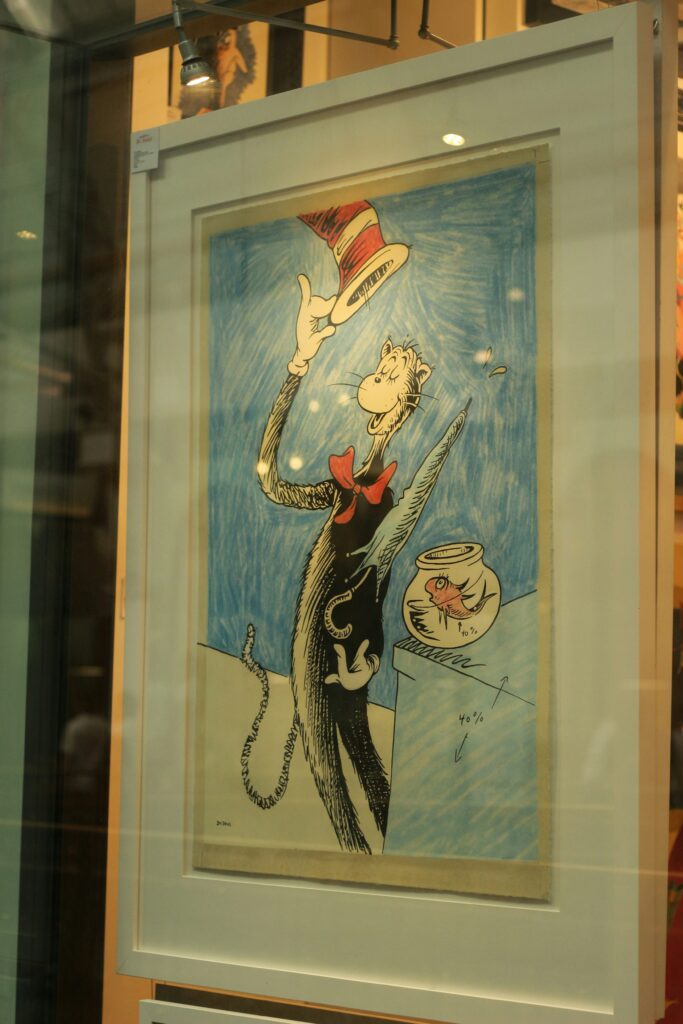
“The Cat in the Hat” was published in 1957 and was written using a limited vocabulary list as a way to improve children’s reading skills. The book was proof that anyone who was starting to read did not need to be simple to be successful; imagination and education work together. March 2nd, Dr. Seuss’s birthday, is associated with the National Education Association’s Read Across America initiative, a nationwide effort promoting literacy.
In recent years, however, Dr. Seuss’s legacy has been seen through a broader cultural lens. It was said that the Dr. Seuss Estate stated that six lesser-known titles would no longer be published due to insensitive imagery (Pratt, 2021). This choice would spark a debate on how society should approach important figures and their works that reflected outdated stereotypes.
Despite the controversy, his most recognized works are still widely read and commercially successful. Adaptations of his stories have been turned into films like “The Grinch” (1966, 2000, and 2018), “The Cat in the Hat” (2003), “The Lorax” (2012), and “Horton Hears a Who” (2008); TV shows like “The Cat in the Hat Knows a Lot About That!” (2010) and “The Wubbulous World of Dr. Seuss” (1996). Quotations from the books are being frequently used in speeches and celebrations. Themes like imagination, perseverance, and individuality still resonate with new generations.
Seuss passed away in 1991, but his presence in American culture remains relevant. His books helped redefine an early stage of reading by proving that constructed learning can and should be joyful. Conversations about representation and history continue to be discussed, and his legacy is not endured as a stable memory, but as part of a living dialogue.
In conclusion, the pages continue to be seen and read. The rhymes still rebound. And for many young and older readers, Dr. Seuss remains a reminder that language can open doors long before we know where the doors lead to.