Discussing denominations: forum held by Christian studies
Emma Ogren, Assistant Editor
Photo by Emma Ogren
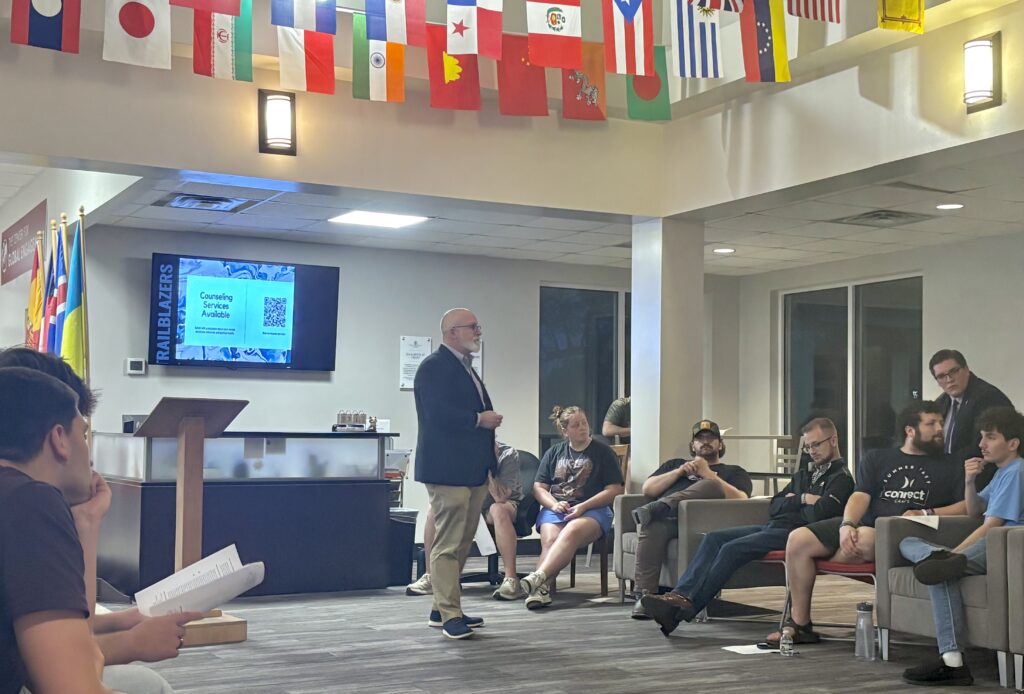
On March 31, 2026, Nathan Finn, executive director of the Institute for Faith and Culture and a professor of faith and culture at North Greenville University, hosted a forum in the Craft/Hemphill lobby.
The forum was titled, “Being Baptist in a Post-denominational World.”
The time opened with some mingling and then a word of prayer that all students attending participated in. Finn also entailed all who attended with a few stories that connected to the topic of the forum.
It was a mix of discussion time and lecturing as Finn explained the topic at hand.
There were 30 students in attendance with most of them hailing from Christian studies or intercultural studies. Ice cream was also served to attendees.
Finn explained that a non-denominational church is, “A church that is not part of a denomination and has no desire to be. It is a part of their identity.”
Non-denominational churches, in his words, confuse tradition with traditionalism. Essentially, they don’t like to adhere to the typical traditions of Christianity, such as communion or baptism, as they see them as outdated.
Finn used a quote by history scholar Jaroslav Pelikan that says, “Tradition is the living faith of the dead; traditionalism is the dead faith of the living.”
He then explained the four benefits of belonging to a healthy denomination: tradition and history (who we’ve been), identity and emphases (who we ought to be), fellowship and accountability (who we are together) and resources and collaboration (how we work together).
During the discussion time, senior Christian studies major Chapel Leroy asked the question, “Why are people afraid to associate themselves with a denomination?”
Finn explained that there is not a single denomination that gets every single thing correct and that people are scared of that. They want to be fully sure of what they’re getting themselves into, but they cannot know if something is wrong.
After this time, Finn discussed further what it means to be a Baptist. There are three different types of Baptist that Finn talked about: the Baptist by conditioning, the Baptist by convenience and the Baptist by conviction.
The Baptist by conditioning is the person who grew up in that denomination and has just continued to live life that way. The Baptist by convenience is the person who is Baptist because that is the church that is closest to them or the one that has the best youth group. The Baptist by conviction is the one that Finn insists we all become. These are the people who are Baptist because their personal beliefs align the closest with this denomination.
There was also discussion on traits that are very distinct to Baptists. Finn talked about the baptism of disciples alone by immersion, local church autonomy, great commission urgency, biblical authority and more. He also explained that these are not exclusive to Baptists, but they are strong to them.
“I don’t trust the government to call balls and strikes on faithfulness and orthodoxy, I don’t trust the government to run a DMV office in an efficient way,” Finn said at the end. “What the government should do is create an atmosphere in which faith can flourish and then get out of the way.”