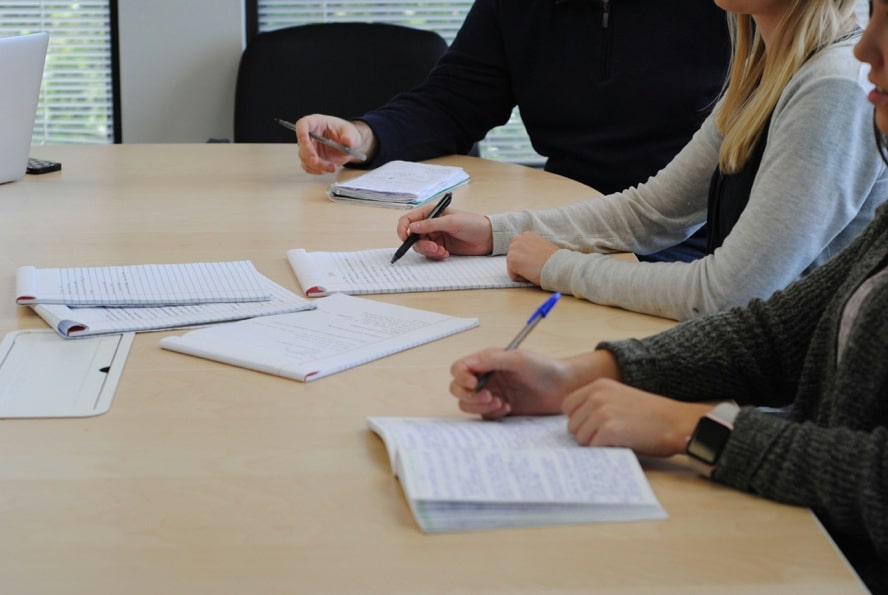
Business students test skills in a high-stakes simulation
Treasure Hardwick, News and Feature Editor
Photo Courtesy of Sarah B on Unsplash
For senior business majors at North Greenville University, the final semester of college isn’t just lecture, exams and essays. It’s practicing running an athletic shoe company.
In the capstone class taught by Bob Shallow, associate dean for the College of Business and Entrepreneurship, students take part in a semester-long competitive simulation called the business strategy game.
Designed by business professionals to mirror real-life scenarios, the simulation places students in executive roles within athletic shoe companies as they compete in a global marketplace with different production facilities.
At the beginning of the semester, students apply for the positions of CEO, CMO, CFO and OO. After Shallow reviews these applications, he picks the CEO, who then goes out and recruit members for the team. From there, the companies play two practice rounds to get acclimated before launching into the real thing.
Each round represents a year, and the teams complete one round a week for ten weeks. Each round requires teams to make hundreds of decisions to accurately capture market share. Every team is a publicly traded company, so the shareholders set up five different goals for the teams. Each team has expectations around earnings, return on investment, return on equity, the quality of image rating of the company and the credit return.
Students are evaluated based on a combination of how their team does, as well as their individual performance. Each team receives two main scores after each round. One score is based on how well they met the shareholder goals, and another is based on how they perform compared to other teams.
In addition to these team scores, students have quizzes and a final exam, as well as a team presentation at the end of the semester. They participate in peer evaluations where teammates assess each other’s level of contribution.
Shallow explained that the simulation gives students real-world practice in problem-solving and critical thinking because the game is unlike any other in academia. Students can’t find answers on what move to make next by watching YouTube videos or asking AI because the game is competition with thousands of possibilities rather than one right move.
Not only does the game teach important skills for the workplace, it also gives students an opportunity to grow and change over the course of the semester in the class.
Shallow said he begins to see students change around the three-week mark of the game, as students begin to recognize the weight of the coursework and begin to direct their full attention to tasks.
“Everybody gets a little overwhelmed or stressed, and so they see over the course of the semester that they have to have more strategy and that they need to meet with the team more,” Shallow said. “As they go along one of two things happens. They either get totally or completely overwhelmed, or they start to figure things out and do well.”
The game requires three to four hours of work each week for students. The competition and challenging nature often lead future students to worry about taking the class. But, while the game is difficult, it’s the pressure reflects the realities of the business world
Embre Todd, senior business major, explained that the game has pushed her to think differently about decision-making and strategy.
Todd explained that the uncertainty of the game has been stretching and that she has had to think through decisions in the business world that she has never considered before.
“Even the fun, easy simple decisions are much more complicated than I thought. Not bad complicated, just realistic complicated,” she said.