
Midterms matter: A guide to the 2026 elections
Solomon Palmer, Staff Writer
Graphic by Ava Stephens, News and Features Editor
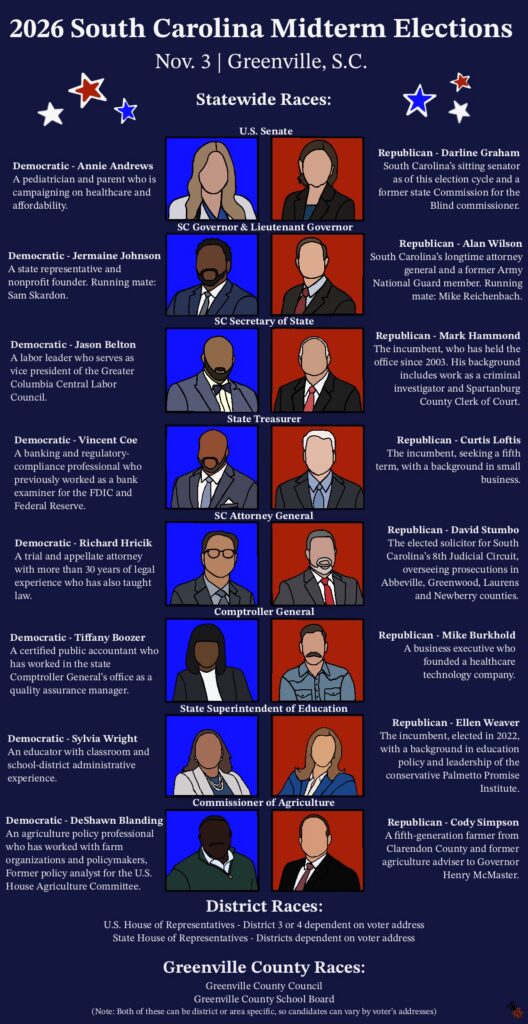
With the presidential term at its official halfway point, local midterms all across the country are underway. Instead of casting ballots for who will lead the country, this election season is to choose who will run and steward our community.
The midterm elections are often overlooked, as national politics dominates the news and social media. However, not only do local politics have a direct effect on the federal government, but local politicians have independence and powers not even available to the president according to the 10th amendment.
With each state and community having its own values and challenges separate from even the next county over, there are some policies we can never hope to pass through national government elections, but rather local involvement. Additionally, the nuanced cultural shifts of each state also cannot be accounted for by the federal government.
“Most people are assuming that South Carolina will vote Republican, as it has reliably in the past. But recent polls and interests are shifting democrat, as far as the state senate race is concerned,” said Jong Eun Lee.
Lee is a political science professor at North Greenville University who observes the state of politics. Due to circumstances around gas prices and data centers, Annie Andrews is receiving surprisingly more support than is expected for South Carolina.
Lee has been teaching at NGU for four years, and got his doctorate in Washington D.C. Since he went to college and graduate school in the political capital of the country, Lee ate, breathed and slept politics. As a resident of the District of Columbia at the time, Lee and other D.C. residents were much more affected by the choices and bills passed just a block away.
“Washington D.C. was not only influencing the country, but being influenced by the larger world outside of America; people from countless countries have moved to be under and involved in American politics,” Lee explained.
Unfortunately, many American citizens do not take advantage of their power to vote, let alone know how to. As Lee puts it, many withhold their vote out of preemptive defeat or due to being uninformed.
“A lot of people don’t vote because of a lack of awareness, regarding who the candidates are or the needs for the community. The news usually only covers national politics. Being in a one-sided district is also discouraging; feeling that a certain candidate will win anyway so your vote does not matter.” But as Lee said earlier, even states as consistent as South Carolina are subject to change.
Not only is local political involvement important, but state politics carry substantial weight on a national level. In addition to the obvious ways, such as electing a state senate, local shifts are a powerful communication tool for those running for president.
“Local political outcomes send a message to larger politicians; it tells them what will happen when their election season comes,” Lee said. “It sends a direct message from the individual states to outline collective interests and expectations, forcing them to prepare to meet them.”
With several polling stations near NGU, and early voting season just halfway done, participating in the 2026 midterms has never been easier. The three closest polling stations are the Greenville Tech NW Campus (8109 Whitehorse Road), Greenville County Library Five Forks Branch (104 Sunnydale Drive) and Cedar Grove Missionary Baptist Church (206 Moore Street).
For in-depth information on candidates and just how many federal offices you have a say in, visit The Pour Over’s 2026 Midterms Guide and select your state.
