The transfer portal from a Trailblazer’s perspective
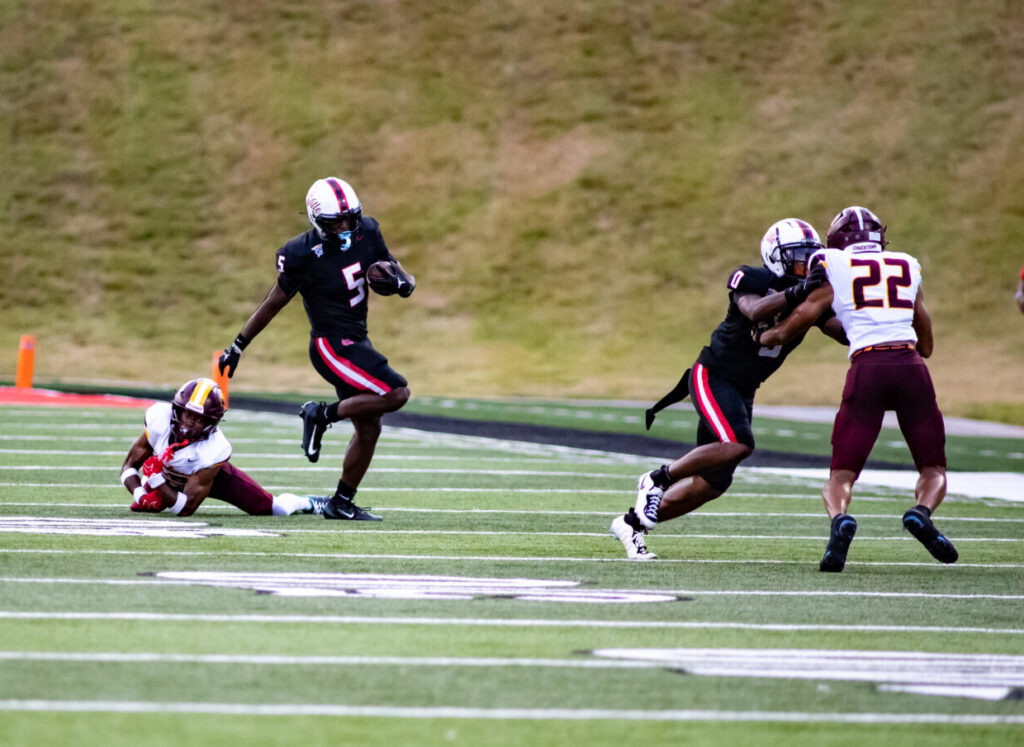
Photo Courtesy of Robert Gawrys
Ian Johnson, Sports Editor
Since 2021, the NCAA has allowed its athletes to transfer schools with immediate eligibility. This decision started the chaotic roster changes that we see every off-season. Originally, this change only affected the top teams at the Division I level, but as the years went on, more athletes began taking advantage of the opportunity to transfer. For the North Greenville University Trailblazers football team, transfer athletes have played a large part in the team’s success over the past couple of seasons.
For these athletes, entering the transfer portal was the best decision for many reasons. For running back Jackson Parrish, transferring gave him a better opportunity to reach his goals. Since the age of three, the goal for Parrish was to make the NFL.
Parrish began his career at Barton College, where he was the backup running back in his freshman season. In his second year at the school, he earned the starting position. He finished the season rushing for over a thousand yards and earning All-Conference first team honors.
“I had 1,000 yards, but it was because I was force-fed the ball,” said Parrish. “Also, we weren’t winning.”
Despite the individual success, the team finished 3-8 in both seasons that Parrish was on the roster. He believed that the best decision for him was to enter the transfer portal. For his next school, he wanted to go somewhere that he was wanted on the field and somewhere he could grow in his faith.
In the portal, he received many different opportunities, some at other Division II schools and some at the Division I FCS level. During the week in which he was supposed to take a visit to a DI school, he got a call saying that they overbooked and couldn’t let him visit until the following week. By pushing it back a week, the decision to play for the school had to be made before visiting the school because school started that week.
“I want to know where I’m going. I don’t want to feel forced or pressured into anything,” said Parrish.
He declined the chance and eventually decided to come to NGU.
“NGU would never pressure me,” said Parrish. “They gave me a lot more time than I told them it was going to be. They were really good about it.”
For Parrish, he could tell that they cared about him. NGU was the place he could win at on the field and get closer to God.
“I have a heart for bridging the gap between athletes [and] students and pointing them to Christ,” said Parrish.
For senior defensive back Khaliq Holland, the transfer portal allowed him to be closer to his family. Holland began his college football career at Indiana Wesleyan University (IWU). IWU participates in the National Association of Intercollegiate Athletics (NAIA). Similarly to Parrish, Holland spent his first year as a backup before earning a starting spot in his second season.
Over his two seasons at IWU, the team won the conference both seasons and made the NAIA playoffs each season, reaching the quarterfinals in 2024. After his sophomore season, he entered the transfer portal.
“I looked at what I did in these last two years, and I thought it was solid enough to move up a division and find a way closer to home,” said Holland.
In the portal, NGU was one of the first schools that reached out to him.
“When I came on my visit, they showed a lot of love; the whole staff made sure to greet me,” said Holland. “They showed me around campus and showed me a 20-year plan, not a four-year plan.”
Going into his senior year in college, he wanted to go somewhere where he could have fun playing and where his family could watch him on the field and walk across the stage.
“When I graduate, I wanted them to be able to see me on stage,” said Holland. “I don’t want to make that a hassle for them.”
While family was the major factor for Holland, Everett Joyner left because of playing time. Joyner, a redshirt junior tight end, previously attended Wingate University. During his time at Wingate, the team made the playoffs 2 years in a row and won a conference championship. Though the team succeeded, Joyner wanted more playing time.
“When I hit the portal, I was looking to fill the role and be somebody’s big top tight end,” said Joyner.
Joyner received a mix of Division II and Division III offers but ultimately chose NGU.
“I followed NGU first, and then they ended up following me back,” said Joyner. “They ended up contacting me, discussing some things and I got here on a visit, then committed.”
Whether it’s for family, faith or better opportunity to play, the transfer portal has been a great help to many athletes, especially those on the NGU roster. Quarterback Kam Montgomery, linebacker Jamie Downing Jr. and defensive back Kaliber Hoey have all transferred from other schools and have made an immediate impact.
While some players who transfer get to start immediately, those opportunities aren’t handed to them; they are earned.
“I still had to work; it wasn’t about just coming here and immediately starting. You still got to prove yourself,” said Joyner.
Holland had a similar statement when talking about playing time.
“You still have to earn your job. If you’re not doing your job, you won’t play in a game, and he [Coach Clark, defensive coordinator] stands by that,” said Holland.
Even with constant movement and roster shuffling because of the transfer portal, for players there is better opportunity. At the same time, nothing is guaranteed, as a school may promise things they can’t provide. Entering the transfer portal doesn’t guarantee success, but it can be a great way for an athlete to reach his goals.