Artificial intelligence in content creation
Ezekiel Chilton, Contributing Writer
Feature Graphic by Ezekiel Chilton
What was once a tool made to assist in creativity is now seen as an embodiment of creativity itself. That tool is artificial intelligence (AI), a computer system capable of completing various tasks such as answering questions, gathering resources and organizing ideas for projects.
On Feb. 15, 2024, OpenAI announced the creation of a new AI model called Sora AI. Sora AI is a software that produces videos with the user typing a simple sentence. The video is generated in minutes with perfect three-dimensional characters, great graphics and quality audio. While the quality of video production was questionable when the software was first introduced, AI has been improving in the quality of its video production, allowing it to even compete with quality films released in the cinemas.
The introduction of AI and its use in social media platforms have made many individuals feel unsure about the future of content creation. Jobs such as video producers and editors can be easily replaced with a much cheaper and more efficient alternative.
Many content creators are quick to embrace the negative aspect of AI usage. They see AI as a tool for lazy individuals who do not want to put in the effort to produce quality content on their own and a way to speed up the process of content creation without putting in as much effort as their fellow competitors.
JimJamFilms, a stop-motion YouTuber, believes that the use of AI dulls the essence of creativity in content. “I think it definitely takes away from the homemade aspect,” JimJamFilms stated. “Art isn’t very definitive; art can basically be anything. But I think that it has to be made through a human and not any artificial intelligence because you didn’t make it. So, it takes away the magic. It’s nicer to hear a story from a human being than from a robot.”
For content creators, videos that are displayed for entertainment are not only made to be entertainment and sources of income, but they are also pieces of art that allow creators to express themselves to the public. The introduction of AI in social media platforms allows for content to be produced at a faster pace. This makes it more difficult for authentic work to receive attention and generate revenue.
Shurajit Gopal, assistant professor of communications at North Greenville University, said the use of AI challenges the traditional values of originality. “If you are going to depend on the machine to do it for you, then where is your creativity there?” he stated. “If you go around writing fiction, you use your creative juices to flow into that and develop your story. If you are going to let the computer, write a 350-page novel for you, it will do it. But is that creativity? Absolutely not.”
Using AI in content creation not only affects original content creators by producing content at a faster pace, diverting more attention to AI-generated content, but it also creates a sense of doubt when questioning originality.
“Five years ago,” Gopal stated, “none of us even knew there was going to be something called AI.”
Everything that was made prior to the introduction of AI relied on human thoughts rather than software generation.
When AI was incorporated into platforms, the public began to doubt everything that was posted online. Original content creators have been accused of faking their videos and using AI because of the distrust that has been placed in the system.
Because of this, many argue that the use of AI should be disclosed within the content that is being produced.
“The person should say, ‘Well, I’ve made this and I used AI to generate this,’” said Gopal. “If you use it, you better say it.”
The rise in skepticism about the advancements in AI can lead to a rise in tension between AI users and viewers. While many struggle to grasp a strong sense of trust in originality, others focus on the aspect of responsible AI usage.
Although the expansion of AI’s capabilities is concerning, it also allows others to see the potential new technology has. Many see AI’s improvement as a tool that can overcome issues that block the flow of thinking for content creators such as YouTubers.
AI has not only been seen as a major obstacle in creating content, but also as a tool to overcome obstacles. Content creators have seen it as an opportunity to assist in creating content without jeopardizing the quality of creativity expressed in content such as YouTube videos.
Many see AI not as a replacement for creativity but rather as an enhancement and something to help spark ideas. “I think AI can really help with sorting things and organizing,” JimJamFilms stated. “If I have a hard time coming up with an idea, I’ll go to AI and I’ll ask it, ‘Give me a list of ten ideas in this aspect.’ I’ll read them and brainstorm my own ideas from reading these. It helps with ideas and answering simple questions that may help me.”
However, the use of AI can be balanced when it is used as a supporting tool. It’s just important not to rely on it heavily when generating large factors in projects, like storytelling and screenplay.
A balanced usage of AI is what many claim to be the best way to handle its existence. On one end, people are not completely reliant on a tool that does not think like a human. On the other hand, it is a useful tool that is not being rejected subconsciously.
Gopal believes that many current filmmakers have been able to find a good balance between AI and creativity. “In many cases, artificial intelligence may go on the negative side,” Gopal said. “But it can also go onto the positive side.”
He also explained that some filmmakers use some advanced apps like Google Veo, which is an AI video generator. With this they put in their creative content, such as the type of film they’re making and details of the characters they wish to include. Those parts of it, then, are their creative thoughts, which add the human element.
Artificial intelligence does not possess the means or capability of creative thinking, but operating it can result in individuals questioning the authenticity of content. AI operates as a tool run by algorithms with the purpose of supporting humanity in almost every situation, such as content creation.
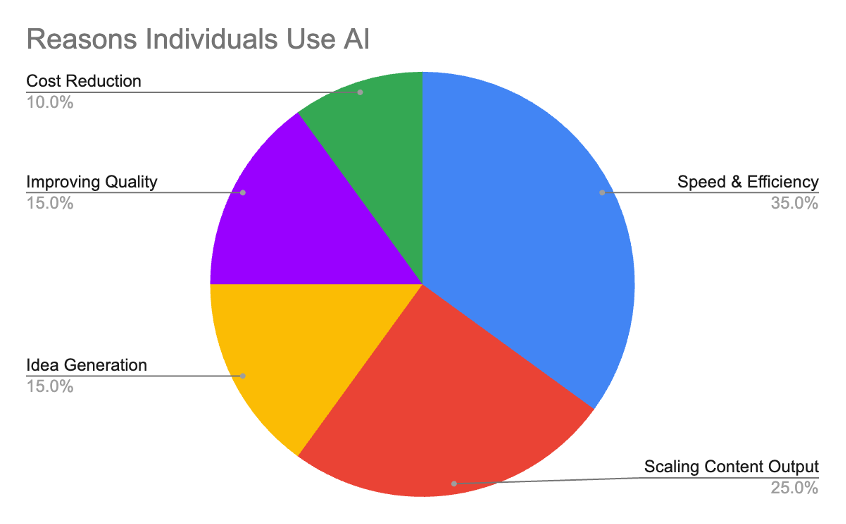
Reasons why people use AI for creating content, according to HubSpot: