More than paint and pixels: when creating becomes worship
CJ Lytton, Contributing Writer
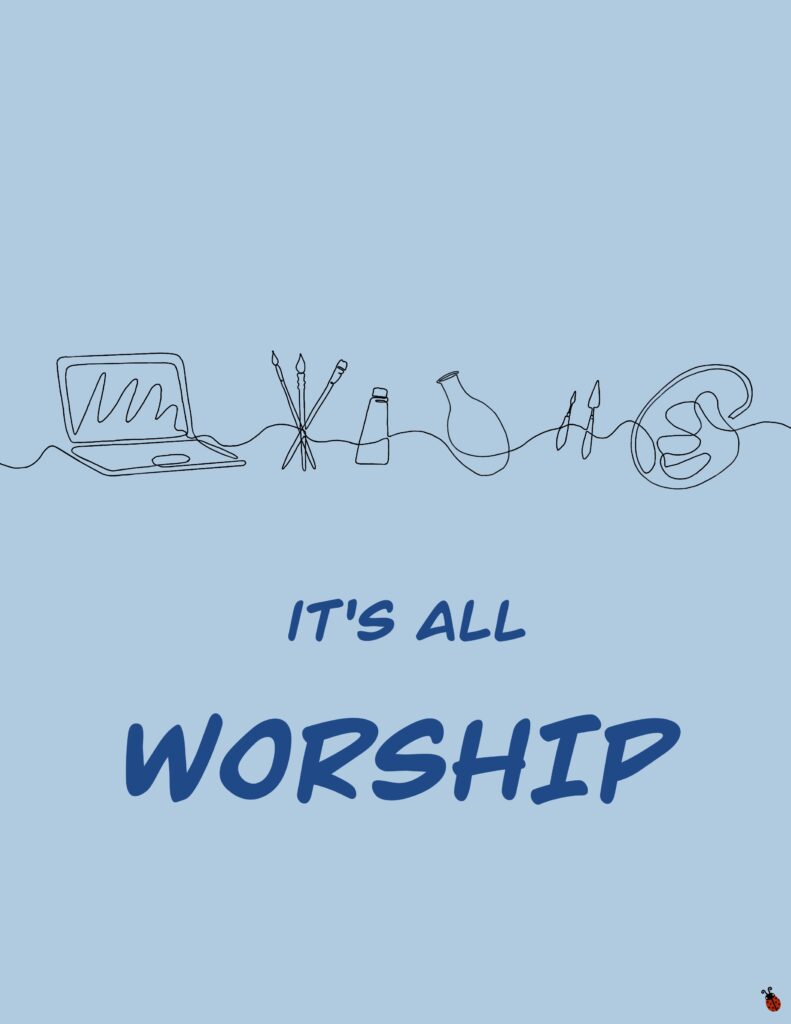
Worship does not always come from the inside of a chapel. Sometimes it echoes from within a studio. From the scratching of charcoal across a paper to the rhythm of a pottery wheel, art professors Zachary Buser and Hayley De Gonzalez believe that creating something is more than a teaching technique. It is an act of worship.
At a Christian university where faith is driven into lectures and chapel services, spiritual incorporation might be expected. But inside the art department, belief takes on paint, clay, digital layouts and sculpture. For Buser and De Gonzalez, creativity is not separate from worship. It is one of its many expressions.
When Buser became a Christian at 17, he said his understanding of the world changed significantly. “I no longer saw it as just materials interacting with other materials,” Buser said. “I saw a reason behind it. I saw God behind all of that.” This shift didn’t just alter his beliefs. It reshaped his art.
Buser, who teaches painting, drawing and printmaking, does not divide his work into religious and secular categories. “It’s not that I’ve got this body of work that doesn’t involve God. I don’t view it as that. To me, it’s a total thing. All this work is to the glory of God.” He said.
He describes his studio practice as part of a “larger dialogue.” Buser said, “My work is a messaging system. It’s about the transcendent. The beauty in this world is leading to the transcendent.”
Working physically with materials matters deeply to him. “I find the visceral quality of real things, real experiences instead of mediated experiences. I respond better to that,” he said.
For Buser, the act of making art is “communal,” it is not just between an artist and an audience, but between an artist and God.
“When God says, ‘Let us make man in our image,’ it’s communal language,” he said, referencing Genesis. “I’m inviting God into that to say, ‘Lord, what do we want to do with all of this?’ It becomes this communal thing.”
One recent piece, titled “Look at You Now”, reflects that perspective. It was created in memory of a late friend of his named Blake Smith. Blake Smith was also a professor at North Greenville University who passed away last summer. Buser expresses his sorrow and love for Smith through this art piece. The sculpture is an abstract camera angled upward that points toward heaven.
“It’s about me contemplating where he is right now,” Buser said. “If he can hear me, I love you, man.”
The work does not contain any evident religious symbols. Yet for Buser, it is deeply spiritual.
Across campus, creativity looks a little different in De Gonzalez’s classroom. Computer screens glow on digital screens. Clay spins gradually beneath steady hands.
De Gonzalez, who teaches graphic design, digital imagery and ceramics, believes creative fields can carry spiritual weight even when they appear commercial. “Design shapes what people see every day,” she said. “That carries weight.”
Logos, advertisements and branding campaigns influence culture constantly. De Gonzalez challenges students to think beyond the aesthetics and look into the responsibility behind it. “Everything communicates,” she said. “So, we have to ask what we’re communicating.”
In ceramics classes, spiritual metaphor becomes physical. Scripture frequently describes God as a potter and humanity as clay. Working at the wheel gives students a hands-on understanding of that imagery. “There’s something about forming clay,” De Gonzalez said. “It reminds you that we’re formed too.”
Like Buser, she sees her classroom as more than a place for developing skills. Spiritual conversations arise naturally as students question the purpose, the intention and the meaning behind their work.
Their perspectives reflect an idea explored by theologian Francis Schaeffer in his book, “Art and the Bible.” “A Christian should use these arts to the glory of God, not just as tracts, mind you, but as things of beauty to the praise of God.” He said in his book. This suggests that creative works can be representations of worship even without bold expressions of religion.
Creativity reflects the nature of God and that art possesses true value. Not only when it contains religious imagery, but simply because it exists. Neither professor describes art as only academic. Both want to invite students to see creativity as involvement in something that is larger than themselves.
In classrooms filled with charcoal dust and digital light, worship does not always look like raised hands or prayer. Sometimes it looks like painting with colorful colors. Sometimes it looks like carefully place typography. And sometimes it looks like clay forming and being reshaped again.
For Buser and De Gonzalez, creating is more than an assignment. It is a response, a reflection and worship. A quiet involvement in the ongoing work of the Creator.