From marriage to metacognition: a poster symposium you don’t want to miss
Grace Turner, Staff Writer
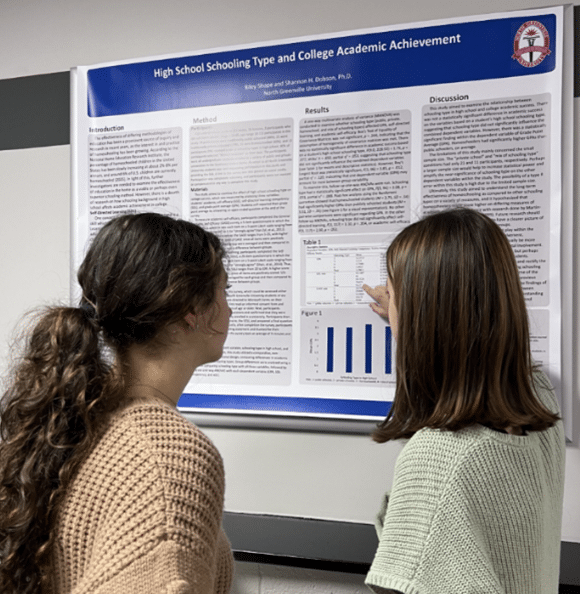
Photo curtesy of Shannon Dobson
On April 30 students of scientific studies at North Greenville University will bring their learning out of the classroom for a one-night exhibition of research.
The symposium will be held from 5-7 p.m. in the upstairs hall of the Crain Science Building.
The poster symposium takes place every semester through the collaboration of several departments including psychology, biology, health science, communications and business. This spring, the symposium will feature students in psychology, biology and health science.
The student researchers come from classes such as research methods in social science, research practicum in psychology, senior seminar in biology and research analysis and writing in the health science department.
The sponsors for the symposium are Shannon Dobson, the chair of the psychology department, and Christina Eddy, a professor of biology at NGU. They have been putting on the symposium for the past 15 years.
In the spring of 2010, Dobson and Eddy attended a council on undergraduate research and began thinking that they needed something to showcase student work at NGU. Upon their return they put the idea into motion and the poster symposium was born.
Dobson expressed that it is part of being a growing scholar to take your experience and knowledge and then communicate what you did.
“Parents never go to class with their kids,” said Dobson, “so it’s cool to see their children presenting scientific research. They are able to see their son or daughter in a different light.”
Three students presenting research this spring include senior psychology majors Abigail Buras and Joel Herman as well as junior psychology major Riley Shope. All three are participating in the symposium as part of research practicum in psychology.
At the symposium, Herman will be sharing his study on metacognition, which he describes as “thinking about thinking.” More specifically, he is studying about calibration in the classroom. An example of this is people being able to gauge how well they did on a test.
Through collaboration with the Intro to Psychology class, taught by associate professor of psychology Bradley Gregory, Herman has been able to study classroom calibration by giving students a check in and check out. On these forms students say how well they think they will do and how well they think they did. Herman’s prediction is that students will become more accurate from check in to check out.
“Essentially they will know better what they know and what they don’t know,” said Herman.
Herman was inspired to do this project through work studying alongside Gregory and learning from his knowledge on the subject. This opportunity introduced Herman to different theories on metacognition and showed him how this learning could be beneficial in his own life.
Shope, will also be exploring metacognition in the symposium with her project entitled “The Illusion of Explanatory Depth.” Her study explains how people may believe they have a deeper understanding of something than they actually do.
In her research, Shope asked people to explain the technology of everyday objects such as a zipper, a bicycle or a piano. She discovered that although we are familiar with something, that does not mean we can explain how it works.
Another project featured at the symposium will be “Technoference in Marriage” presented by Abigail Buras. Buras is studying the relationship between technology and marital satisfaction.
In her study, Buras investigated how technology can disrupt quality time in a marriage as well as cause more conflict with couples arguing about how much time their spouse spends on a screen. Buras collected data by polling married couples and asking questions such as how often they find themselves arguing about phone usage.
What prompted this project for Buras was a study of the book Anxious Generation by Jonathan Haidt in her senior seminar course as well as her own upcoming marriage. Buras plans to continue this study by pursuing a masters in marriage and family therapy and becoming a marriage counselor.
Buras and Shope encouraged their peers to come and check out the symposium and support each other in their endeavors.
“People go to plays and concerts,” said Shope, “And this is also hard work for the students.”
Looking toward the future of the symposium, Dobson and Eddy have begun considering what it would be like to do a university wide research day where students from all departments share their educational projects. The idea for the broader research day comes from Furman University who holds a day of this nature.
Students would share research results, musical pieces, plays, lectures, sermons and other projects that demonstrate what they have been working toward in their field of study.